
At the Sign of the Lion” is a six-page Wolverine story, written by Jo Duffy with art by Ken Landgraf and inks by George Pérez, first published in Marvel Comic #335 in the UK in March 1979. Set entirely in a bar, it finds Logan brooding over Jean and Cyclops until a loud, attention-seeking Hercules barges in, picks a fight over a barstool, and ends up smashing the place with him before the two finally recognize each other as fellow warriors and outsiders. What began as an emergency inventory piece for Marvel UK has since been placed by historians between Uncanny X-Men #110 and #111, and is now understood to predate Wolverine’s better known “first solo” outings in Uncanny X-Men #133 and the 1982 Wolverine mini-series.
As commentary for the “Secret Friends Unite” podcast in 2026, Mike Washburn asked her a question about it afterward, and she responded.
Mike Washburn: Jo, I’m really curious, you mentioned that “At the Sign of the Lion” sat in a drawer for years and years and years, do you remember when you actually wrote the story?
Jo Duffy: At the very start of my career. I think it was the first story I wrote for Marvel. I’d say late in 1977.
It’s been reprinted numerous times, including the Wolverine saga, a personal favorite.
Years later, it’s easy to take this for granted, because, after this issue, Wolverine spent time in bars over and over again, in Madripoor, New York, Canada, etc. It’s so basic to his personality, and to how the moviegoers see him. Remember that Bryan Singer first showcased who Wolverine was in an environment like this in the first X-Men movie.
The story is important because it is Wolverine’s earliest solo spotlight, the first time a female writer scripted him, and the first Marvel inking job by George Pérez, all wrapped in a rare, disposable British weekly. I love the artwork, story, and the fun classic marvel mashup of two misunderstood heroes, Hercules and Wolverine. More importantly, this unique story helps set the tone for the behind-the-mask persona of Wolverine. Here is a color reprint of the first page below. The original is in black and white. True to form, we see Wolverine has always had a thing for red heads.
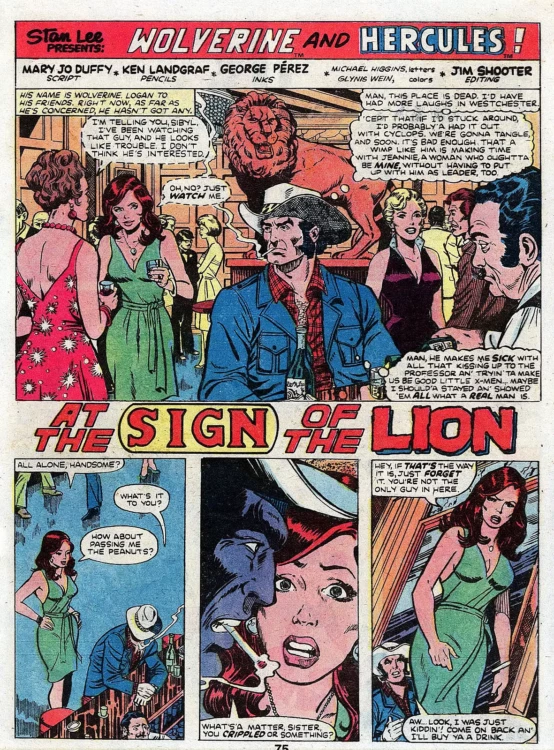
Historian Mike Washburn asked script writer Mary Jo Duffy about the story:
Mike Washburn: Hi Jo! For your story “At the Sign of the Lion,” did you come up with the idea of Wolverine being in a bar setting? And was it your idea to make Hercules the antagonist? It feels like a pretty unexpected matchup for Logan to be scrapping with.
Jo Duffy: Thanks for asking! Absolutely everything about that script was entirely my own. I had never written for Marvel before, and there was no editor attached to the story or anyone giving me any kind of direction. I came up with it as my audition piece, simply because at that point, I felt there was a bunch of interesting things that could be done with Wolverine, who had never appeared in a solo story before. He was a character I loved from the start. In fact, I think the first letter I ever had published in Marvel’s letter columns was probably a response to his introduction as a guest antagonist for the Hulk. Putting Hercules into this story was also my own idea, simply because I thought he was a very entertaining blowhard at the time. Of course, Ken Landgraf gets every iota of credit for the wonderful pencils, since this was also his audition job. And George Perez gets credit for being an absolute peach of a human being, because he was already quite a star at the time, and volunteered to ink the story as a favor to me, due to our friendship. He made Ken and me both look are very best.
Mike Washburn: Jo Duffy Thanks for responding! This is so interesting! Wow, thank you for that detail, I had no idea this was an audition piece! The common historical narrative has always been that it was an inventory script commissioned by editorial, so hearing that you created this entirely on your own as a ‘spec’ script to get your foot in the door is a huge revelation. Since it was an audition, were you surprised when they actually decided to publish it? Did Archie Goodwin or Jim Shooter pull it out of a pile later, or was it accepted immediately?
Jo Duffy: Jim accepted it immediately. He was great about that. He did have requests for some dialogue alterations, some of which I made, and some of which he reconsidered after we discussed them. It would never have gone to Ken if it had not made the grade. it would have been too unfair to make him audition on a script that wasn’t up to snuff in the first place. Back then, by the way, writers came up with their own stories. At Marvel, at least. Editors could either accept, reject, or accept, edit, and make suggestions. The mythology that some people have recently spread that editors were actively involved in the writing process is entirely that: mythology, and pretty self-serving at that. I say this as someone who was both an editor and a writer of that era. Both writing and editing are important and demanding jobs, and you need both for a comic to be successful. But when we published these things for a rather small (though passionate) audience, for little money and no fanfare, people did their own work without trying to also claim credit for the work of others, too. I have no idea who made the decision to publish the story, Nor when. Things of odd length, like audition pieces, tended to be held until there was a need for a certain number of pages featuring a particular character to complete an issue or a treasury. I never doubted it would see the light of day at some point, but I don’t think I knew that it had until it was already in print.
Join us for more discussion at our Facebook group
check out our CBH documentary videos on our CBH Youtube Channel
get some historic comic book shirts, pillows, etc at CBH Merchandise
check out our CBH Podcast available on Apple Podcasts, Google PlayerFM and Stitcher.
Use of images are not intended to infringe on copyright, but merely used for academic purpose.
Images used ©Their Respective Copyright Holders
