
Read Alex Grand’s Understanding Superhero Comic Books published by McFarland Books in 2023 with Foreword by Jim Steranko with editorial reviews by comic book professionals, Jim Shooter, Tom Palmer, Tom DeFalco, Danny Fingeroth, Alex Segura, Carl Potts, Guy Dorian Sr. and more. Now available in audiobook, click:

In the meantime, enjoy the show:
Ed Gein hit at the perfect moment in 1957, when TV news and photo-heavy magazines could beam a farmhouse of nightmares into every living room. His case offered filmmakers mix-and-match images, the mother fixation, the skin mask and bone décor, the idea of a woman suit, all easy to lift without the biography. That domestic, rural horror felt new, turning the ordinary home into the scene of the crime. Out of those pieces came three enduring figures in the genre: Norman Bates, Leatherface, and Buffalo Bill. By contrast, earlier killers with far more victims, like H. H. Holmes, Belle Gunness, Albert Fish, or the Cleveland Torso murderer, never got the same TV-age spotlight or pop-culture afterlife. So Gein’s legacy is less body count, more a ready-made toolkit that modern horror keeps raiding.
After watching the Netflix series, and reading up on this troubled schizophrenic killer, I looked up some comics that tackled the question of who he was, and then decided to look at newspaper articles that covered him in real time as well as the movies that capitalized on his grisly activities. Here are some Ed Gein comic books of note:


That all being said, I went through old newspaper clippings that documented the drama around his 1957 capture in real time, which document the media sensation around the public’s discovery of the 10-15 bodies decorating his farm house.


Here is Ed Gein’s house and the hardware store that one of his confirmed victims, Bernice Worden owned:

His other confirmed victim, Mary Hogan was also a business owner who ran her own bar with some details of the crime scene:
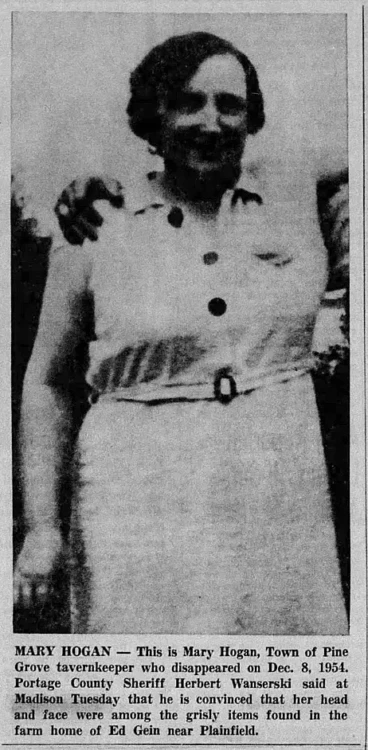


This article says: Mary Hogan, a tough 5’8″, 200-pound tavern owner twice divorced and known for handling rowdy drunks, was last seen locking up at 4:30 p.m. on Dec. 8, 1954. The next day the bar stayed closed, the sheriff forced entry, and a pool of blood was found on the floor, after which no one saw her again until Gein confessed.


This article says the Distric Attorney Ed Kileen seeks a murder warrant for Ed Gein in Bernice Worden’s case and would accept an insanity plea, but he opposed digging up graves to verify Gein’s grave-robbing claims, citing cost and lack of local missing persons. He’s awaiting fingerprint and ballistics tests on a .22 rifle and, after a caution from the state AG, says he must protect Gein’s fair-trial rights despite press interest.

Former Wisconsin assemblyman William Belter agreed to defend Ed Gein after Gein asked for him. Gein was being held on a robbery charge for $41–$42 from Bernice Worden’s store while authorities investigated her death and the skulls found at his farm. Belter, a 1949 University of Wisconsin law grad, said he would enter a plea of not guilty by reason of insanity, noting it would be his first murder case and unlike anything he’d seen.

Gein’s lawyer is here to the left, with the police chief to the right.

Turns out cops held Gein for robbing Bernice Worden before they could find more evidence. The sheriff described grisly finds at the farm, including skinned heads made into “death masks,” other items fashioned from human skin, and a heart in a pan, while lab staff said they could not yet identify Mary Hogan’s head among the trophies.


The chief of police and Ed Gein took a nice glamour shot at the time of the arrest.

This article confirmed that he indeed babysat people’s kids. (yikes!) Officers said Ed Gein likely worked alone, a quiet handyman and occasional babysitter who confessed to grave robbing while psychiatrists evaluated him. Investigators widened the search for additional victims, with reports speculating the total could reach about fourteen.


Here is Bernice Worden, one of his confirmed victims.

Here is a photo and statement by supposed ex-girlfriend, Adeline Watkins, who was 50 years old at the time of Gein’s capture. She describes him as very wholesome, with a fondness for reading books on Lions, Tigers, Africa and India. She told the Minneapolis Tribune she and Ed Gein had a 20-year romance and that on their last date, February 6, 1955, he proposed; she said she declined not because of him but because she doubted herself. She described Gein as “good and kind and sweet,” a polite man who preferred drugstore milkshakes to taverns, liked reading about far-off places, and often discussed murder cases with her, while her mother recalled he always had Adeline home by 10 p.m.
She is depicted in the Netflix series, with a lot of dramatic exaggeration.


This article points out that Gein’s older brother was going to marry a woman and split the farm, and that Gein talked murder cases with Adeline Watkins as a fan of Western and Detective pulp fiction. He was born in La Crosse in 1906 and moved at age eight to a 155-acre Plainfield farm, where he mostly stayed. He went to a nearby country school, helped on the farm, and in the 1930s visited an uncle in St. Croix Falls, then lost touch with many relatives. After his father and brother died in the early 1940s, Ed did odd jobs, babysat and kept clipped murder stories in a shoebox. He was underweight, ate simply, preferred soda to beer, was classified 4-F during World War II because of an eye issue.

Various articles had different bits of information like this one showing his bed, kitchen, the crime lab he had his lie detector tests in, and a view of the Plainfield cemetery he would take his bodies from.


Here is a photo of Bernice Worden’s funeral.

Gein gained international fame, shown here in this London, England newspaper:

Here is one article covering how his house burned down, and it was thought of as likely being set on fire. In this article, the son of one of his confirmed victims, Frank Worden is named here as the chief of the local fire department. Fire crews found the house engulfed when they arrived, with wind and thawed ground erasing tracks, and the blaze followed rising local anger over people trying to profit from the property and talk of turning the site into a museum. An auction of his effects had been set for March 30 while he was held at Central State Hospital.


There were bones of anywhere from 9 to 15 people in his house. Meanwhile his neighbors talked about a never-ending grin he was sporting. The lie detector, which isn’t accurate in schizophrenics, cleared him of other charges of close by victims of foul play, including fellow baby sitter 15 year old Evelyn Hartley. Chicago Tribune’s Jan. 10, 1954 recap says Evelyn Hartley vanished while babysitting in a well-lit La Crosse neighborhood on Oct. 24, 1953. Her father and neighbors found the house locked, radio on, furniture disturbed, Evelyn’s glasses and one shoe inside, the other shoe on the basement steps, a basement window screen pried out with a small ladder beneath it, blood inside the house and in the yard, and bloody handprints on nearby buildings; tracks suggested she was carried to a waiting car. The evidence points to a violent abduction and likely homicide, but her body was never found and the case remains unsolved.


Gein only admitted to the two murders, but not Evelyn’s. Investigators planned lab tests on the skulls for traces of embalming fluid to help tell grave-robbed remains from “fresh” victims. Officials discussed/arranged a 30-day mental observation at Central State Hospital to assess his sanity during charging.

Turns out, people paid money to see his “Ghoul Car.” A Seymour fair let a promoter show off Gein’s car for 25 cents, dressed up with fake blood and victim dummies, while turning down the Wisconsin Association for Mental Health’s request for a public-service booth. The editorial rips that choice as a grim sign of our appetite for gore over education and a reminder that we ignore the mental health issues that produce horrors like this.

People also paid for whatever items that were auctioned off. About 2,500 souvenir hunters packed the auction as Ed Gein’s 195-acre farm and a handful of outbuildings sold for $3,925 to real-estate dealers Emden Schey and Allen Little, who said they planned to plant trees on the property. In the preview week more than 20,000 people tramped the grounds, the house had already burned, and officials were still eyeing arson. Bidding ran about an hour and a half, with odd lots moving cheap, from a rusty axe head for 25 cents to chicken coops, wagon wheels, a metal stool for $14, and a manure spreader for $36. Chet Seales paid $215 for Gein’s 1940 pickup truck, and the 1949 Ford sedan fetched $740. A brief stir erupted when a mound behind the ruins was spotted; deputies roped it off and said it would be opened later.

This article from the Nashville Banner in November 1957 explores Gein’s twisted relationship with his mother. The article centers on what psychiatrists said was driving Gein: a psychotic desire to be a woman, rooted in an intense mix of love and fear of his mother. Around that, it sketches the “two lives” idea, with Gein appearing as a shy, helpful bachelor while secretly robbing graves in the sandy Plainfield soil. It recounts the family history, his growing isolation after his mother’s death, and reports that he lingered at funerals and sometimes dressed in women’s clothes. The piece even puzzles over how he opened graves so fast and moved heavy bodies, but keeps returning to that core motive as the key to understanding his crimes.


This one shows a summary of known facts a year later as well as Gein’s current doings at the Central-State Hospital for the Criminal Insane. Locals remembered Gein joking to neighborhood kids that he was “dressing his deer,” and the paper spells out the gut-punch that the “deer” in his shed was Bernice Worden. Central State’s superintendent says Gein is doing ordinary menial tasks, has made a “satisfactory adjustment,” and has had no visitors except officials, with no sign he will ever return to court. The farm is now just a blackened foundation after a fire most people think was no accident, the land was sold off cheap, the outbuildings are coming down, and new owners are planting evergreens. Around Plainfield the frenzy has cooled, and even the graves he claimed to rob were not all opened, a reminder of how much about this case still sits in the dark.

David Burk wrote a small bio on Ed Gein in 1958 with some insight into his relationship with his mother. It recounts a neighbor, Elmo Ueck, saying that days after Mary Hogan vanished Gein brushed him off with “she ain’t even missin’,” then claimed she had simply walked out. It leans into Gein’s home tinkering by saying he experimented with tanning hides and upholstery and that masks and other pieces were kept in a lighted room. It also walks through the Bernice Worden timeline in more step by step detail, describing how he returned to the store, moved the body to his vehicle, and brought it back to the farm where deputies later found her in the lean-to. It also doubles down on the mother thread. Augusta looms over every detail, the strict, joyless woman who preached that other women were evil and drilled modesty into him while he hovered as an obedient son. After her strokes he nursed her closely, then lived in a house that treated her rooms like a shrine, and when she died he slid into deeper isolation. The piece says psychiatrists framed his crimes as a warped attempt to become the mother he loved and feared, which tracks with reports that he lingered at funerals, sometimes dressed in women’s clothes, and tried to re-create her through the skins and masks he kept.


In 1960, Alfred Hitchcock made the film, Psycho based on Robert Bloch’s book, which reporter Will Jones attributes as inspired by Ed Gein.

Although everyone saw the Gein connection, Hitchcock, possibly for legal reasons, tried to distance the work from Ed Gein:

In 1962, there was an update on Ed Gein’s status. A year on, Judge Herbert Bunde told an Elks Club crowd that Gein would never leave the state hospital and that the case would likely never come to trial. He called Gein a model patient with a rare psychiatric condition rooted in an overpowering attachment to his mother, which twisted into a desire to become a woman and drove him to hide his crimes. Bunde said Gein kept books on surgery and embalming tools, made a recognizable mask from Mary Hogan’s head, and believed fresh bodies or even self-surgery might help him achieve his aim. He knocked down rumors of cannibalism and said the heart found in a bag was tied to his fixation on transforming himself, while confirming human skin was used to upholster a chair back and to make a lampshade, with remaining evidence held by the state after the farmhouse fire. His view was that justice was done because medical testimony showed Gein was mentally incompetent.


1968 status: A judge tossed the robbery charge over the cash register because the state could not prove the one found at Gein’s home was taken from Worden’s store, but the murder case moved forward. Witnesses and lab staff described the .22 rifle from Gein’s house as the gun that killed Bernice Worden, and officers testified to blood on the store floor and to finding her decapitated body hanging in a shed at the farm, with her head nearby and other parts and grave-taken remains in the house. Worden’s son said Gein had been “shadowing” his mother and asking her out, and a deputy confirmed seeing Gein with a rifle in town the afternoon before she vanished. Gein sat silent in court and waived a jury, then was found not guilty by reason of insanity and committed, with the judge also ruling him incompetent on the dismissed cash-register count.

After ten years at Central State, Gein was ruled competent to stand trial, yet many original doctors and witnesses have died and newer court rulings on search and seizure could complicate things. A hearing was set to appoint counsel and let the judge decide if Gein is ready for trial. The case first exploded because the farm turned up multiple human remains, most taken from graves. Gein was charged with the 1957 murder of Bernice Worden and was also named in a warrant in the 1954 death of Mary Hogan.


status in later 1968: Ed Gein took the stand for 90 minutes and said he went to Bernice Worden’s store on Nov. 16, 1957 to buy antifreeze, then returned to look at a .22 rifle he claimed he wanted to trade for. He testified the rifle in the store felt unfamiliar, went off, and Mrs. Worden fell, and he said he could not remember what happened for the rest of the morning. A psychiatrist, Dr. Milton Miller, told the court Gein had a chronic schizophrenic disorder long before 1957 and had admitted a history of grave robbing. Gein was shown state crime lab photos of Worden’s body and said he did not remember seeing anything like that at his farm. The bench trial was to decide whether he was sane at the time of the killing, while the Mary Hogan case was raised on cross-examination though he was never formally charged in that death.

1974 article says that Texas Chainsaw Massacre is based on Ed Gein:

1974 status of Gein: Judge Robert W. Gollmar denied 66-year-old Ed Gein’s bid for release, ruling he remains mentally ill and must stay at Central State Hospital. The court recapped 1957 evidence like furniture made from human remains, death masks, and a heart on the stove, and noted he was charged with Bernice Worden’s murder but later found not guilty by reason of insanity. Hospital officials said releasing him would be dangerous and that he lacks the strength to cope outside. Psychiatrists opposed moving him to lower security. Gein works as a carpenter and mason in the hospital, said he is unhappy, and lost his appeal.


A 1974 article assumes that he gained some influence or inspiration from Ilse Koch, the “Bitch of Buchenwald,” who reportedly collected lampshades from concentration camp victims. Gein doesn’t confirm that himself.

Ilse Koch is here to the left from 1948, and to the right is the 1975 sexploitation film that turned her story into a sex horror-comedy:

A 1948 blurb on her said:

1982: A retrospective profiles Judge Robert Gollmar as he publishes his book on the Gein case, calling Gein a unique criminal who mixed grave robbing with making furniture and masks from human skin, and recalling that locals even cheered when the farmhouse burned. It notes the car-turned-sideshow, Hitchcock’s interest, and Gollmar’s view that if Gein ever returned to Plainfield he might not survive. The piece reprises trial highlights, says Gein told examiners he robbed as many as eleven graves, and quotes Gollmar that Gein felt little real remorse and spookily still believed he was doing God’s work. The judge says Gein is still confined in Madison, very controlled and mentally intact, and that he wanted to get the record down before more key people from the case died.


1984 death: Ed Gein died at 77 at Mendota Mental Health Institute, with officials citing respiratory failure from cancer. The obit recaps his two confirmed murders, Mary Hogan in 1954 and Bernice Worden in 1957, and his grave robbing of roughly a dozen graves, with nine skulls, shrunken heads, and furniture made from human remains found at the farm. It notes he was ruled legally insane, diagnosed with chronic schizophrenia, and spent the rest of his life in custody, while Robert Bloch’s book and Hitchcock’s “Psycho” carried his story into pop culture.

A 1990 Orangevale News article assumes it is a fact that Gein was inspired by Nazi, Ilse Koch. There was nothing to support that back in the 1950s.

In 1991, the Palm Beach Post claimed that Gein was also influenced by 1950s transgender performer, Christine Jorgensen, even though there is no quote from Gein himself or that no article claimed that during the time of his arrest:


In 1991, Ed Gein was written as the inspiration of Buffalo Bill in Silence of the Lambs:


There have been some horror films based on Ed Gein directly, but none of them seemed as well put together as Ryan Murphy’s Monster: The Ed Gein Story (2025) took a great deal of creative license in telling his story. The 8 episodes is a dark ride that recreates Gein’s life and its rumors, including his fascination with 1930s and 1940s pulp magazines and possibly comic books. Ryan Murphy threads Gein’s story to Ilse Koch, a grisly predecessor of sorts who was born in the same year and later helped spark the 1970s exploitation film “Ilsa, She-Wolf of the SS,” then cuts to his assumed fascination with Christine Jorgensen, and Hitchcock’s casting of Anthony Perkins for “Psycho.” The mix feels about one third true events, one third long-standing rumor, and one third fabrication, yet the series still does strong work mapping Gein’s disturbed psychology, his warped bond with his mother, and how he helped shape the horror genre through Psycho, The Texas Chain Saw Massacre, and The Silence of the Lambs.
Definitely interesting.
Join us for more discussion at our Facebook group
check out our CBH documentary videos on our CBH Youtube Channel
get some historic comic book shirts, pillows, etc at CBH Merchandise
check out our CBH Podcast available on Apple Podcasts, Google PlayerFM and Stitcher.
Use of images are not intended to infringe on copyright, but merely used for academic purpose.
Images used ©Their Respective Copyright Holders
