
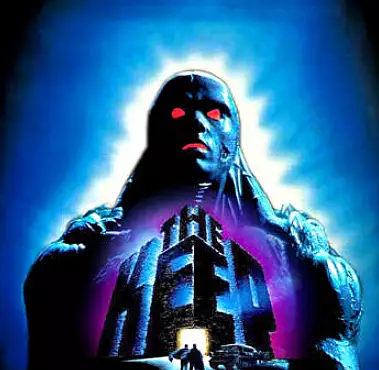
Michael Mann’s 1983 film The Keep is a bizarre Nazi-occupation horror picture about a centuries-old evil sealed in a Romanian castle-an adaptation of F. Paul Wilson’s novel it is perhaps now best known as either the film with the Tangerine Dream score, or that terribly troubled production. Viewed alongside the X-Men series however, one may be more surprised by how utterly recognizable the film’s cast is: for four roles, in particular, repeat in both texts: a millennia-old evil seeking to reform the world, a protector assigned to defeat it, a Jewish prisoner offered control, and a Nazi extremist willing to follow orders: This isn’t a coincidence.
Molasar and Apocalypse

Molasar is what’s inside the wall, a thing of pure evil, trapped within the fortress by beings who both understood it enough to cage it and not enough to kill it. When the German soldiers break silver crosses from the wall in their attempt to unearth treasure, it escapes. Apocalypse, in a similarly almost mechanism, arrives in “X-Men: Apocalypse” (2016): an ancient Egyptian mutant, maybe the first of his kind, buried for thousands of years and reawakened by beings unaware of who or what they are disturbing.
The common thread in both these cases isn’t quite the reawakening as it is the motive. Neither one seeks solely to murder; both want to rebuild what has been established. Apocalypse, of course, desires to torch an imperfect civilization and reign over its ashes as a god. Molasar’s intentions, though much less specific, move in the same direction, outward, spreading, a void not meant to remain imprisoned within its stone keep. Theirs is less a kind of villainy which stems from humanity, and thus more one which demands a specifically defined enemy.
Glaeken and Professor Xavier

That contrast, in the case of The Keep, is Glaeken Trismegestus, the quasi-immortal outsider that comes to the fortress because the very reason he exists is to stop Molasar. He’s the negative to the creature’s image and their battle is more about metaphysics than fisticuffs.
Xavier takes on that role, and it’s his running psychic battles against the Shadow King that offer the cleanest parallel in all of his battles with Magneto and Apocalypse. The Shadow King is an evil astral entity that reflects Xavier in the same way that the creature reflects Glaeken in all ways-and their war is as much ideological as physical. Their difference in texture is one of exposition: Xavier, ever the professor, talks about it with a room of students, explaining his intentions and his purpose. Glaeken never really seems to explain his.Same role-the counter-protector to an old evil, rendered warm and expository in one instance and cold and inscrutable in the other.
Dr. Theodore Cuza and Magneto

What I think is the most striking parallel is the one the filmmakers likely did not intend. Doctor Theodore Cuza is an aging, sickly Jewish historian; brought into the keep by the Germans, precisely because he can decipher what is written there. Molasar preys on him as the creature preys on everyone else; it is a temptation to Cuza that, when it is realized to be irresistible (the offer is power, vitality, the ability to turn the thing in the wall upon the SS officers who brought him, and his daughter, there), he accepts for a good portion of the movie.
Magneto’s two (or more) decades-long character arc is about living within the center of that very same temptation: the Jewish survivor of the Holocaust whose mutant abilities are very real, and whose motivation is genuine, who debates whether or not to turn his power onto those who would hunt him down again, to join with an Apocalypse, or strike out preemptively. The crossroads for Cuza lasts for part of a film; the crossroads for Magneto is the life he leads. Both are portrayals of the same dark fact of life: that one’s experience of utter barbarism might leave them reaching for whatever weapon is closest, and that there is really only the slightest difference between being right and being vengeful.
There is even a structural parallel in the comics: at one point Magneto was restored to a physically young body and then later restored to his true, ancient, old age, a literal interpretation of the restoration Molasar offers Cuza.
Major Kaempffer and Red Skull

The final combination is by far the simplest. Major Kaempffer is the SS officer from The Keep; and he is played with remarkable close adherence to history as an amoral monster whose most frightening quality is that he is merely doing his job within a exterminationist state. The Red Skull is the same state philosophy turned to operatic fever, a Nazi turned into a cartoon monster.
What connects them is the fortress. The Red Skull breaks into a fortress in Captain America: The First Avenger hunting an object called the Tesseract, an object of infinite power. That is more or less Kaempffer’s problem in reverse: a Nazi breaks into a fortress containing something of ultimate power which, like all things ultimate, is far beyond his capacity to understand. In one case, the Nazi is the human, and the horror comes from the wall. In the other case, the Nazi is the monster and the horror comes from him. In between, the two films demonstrate two ways American movies have dealt with that history, through documentary dread and through pulp opera.
Of course, I am in no way suggesting that Mann’s film inspired the X-Men, though it might have been. What it demonstrates is the durability of these four roles-ancient evil, guardian, tempted survivor, believer-and how effortlessly they are recombined whenever the supernatural intersects the actual horrors of the twentieth century. The Keep achieved the juxtaposition in 1983, and then disappeared largely unnoticed, the X-Men didn’t.
Join us for more discussion at our Facebook group
check out our CBH documentary videos on our CBH Youtube Channel
get some historic comic book shirts, pillows, etc at CBH Merchandise
check out our CBH Podcast available on Apple Podcasts, Google PlayerFM and Stitcher.
Use of images are not intended to infringe on copyright, but merely used for academic purpose.
Images used ©Their Respective Copyright Holders
